Measurement
Incoming-water measurements plus a post-treatment optical measurement for feedback.

Enhanced organics removal. Feed-forward prediction with a treated-water measurement to trim the dose through feedback control.
Drinking water
Feed-forward prediction with a treated-water measurement to trim the dose through feedback control.
Software shaped around your process
The value is in the relationship between the measurements, the model and your treatment objective.
Explore the technologyBring together the online water-quality and process measurements agreed for the treatment duty. PMA reviews their location, units and history for the site.
A relationship developed from process evidence translates changes in incoming water into a predicted coagulant demand. The treatment objective shapes the model.
The calculated dose feeds the agreed plant control arrangement. Control limits, the existing dosing approach and operator responsibilities are reviewed before handover.
Compass data / illustrative interface
Read incoming turbidity and dissolved organic carbon (DOC) alongside the calculated dose. In this example, the dose responds to rising organics even while turbidity falls.
Illustrative UI only. Fictional values; trends use separate relative scales. DOC is shown as an optical equivalent (DOCeq). Site-specific calibration and validation are required.
The data behind the model
Incoming-water measurements plus a post-treatment optical measurement for feedback.
Enhanced organics removal within the agreed drinking-water treatment objective.
A treated-water measurement trims the dose calculated by the incoming-water feed-forward model.
Review the measurements, objective and evidence for this application.
From application to control
Define the treatment objective, source variability and current dosing approach.
Bring together online measurements, operating records and laboratory evidence.
Agree the instrumentation generation, measurement arrangement and plant interface.
Establish a site-specific assessment and review the model before the agreed control handover.
Application questions
EOR adds treated-water feedback to the incoming-water prediction, allowing the dose to be trimmed for the enhanced organics-removal duty.
The May 2025 instrumentation pack specifies TriOS OPUS for feed-forward measurement and LISA UV for feedback. Older literature refers to s::can. PMA confirms the configuration for your project.
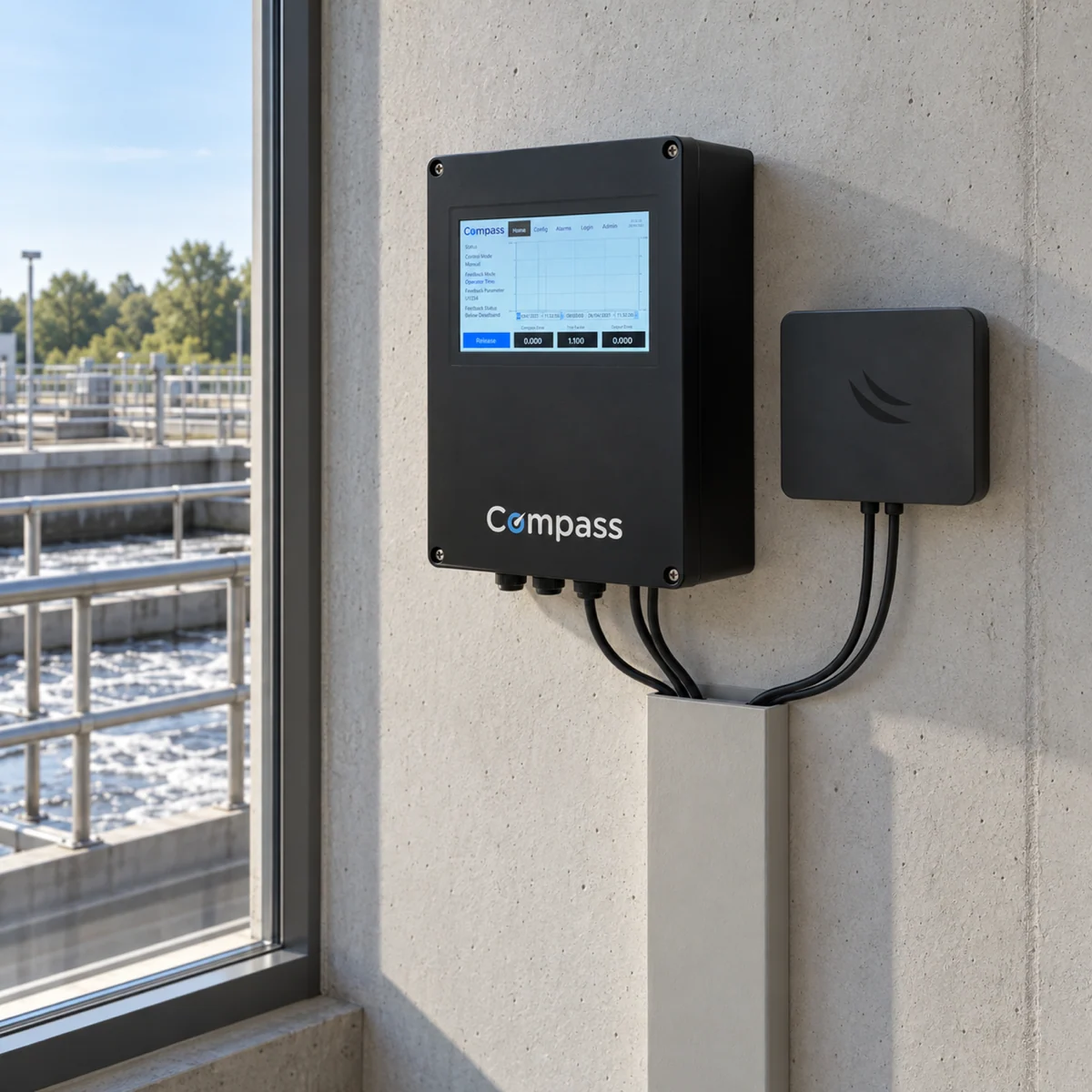
A treated-water optical measurement provides feedback to trim the dose predicted from incoming water quality. The treatment objective and measurements determine the proposed control configuration.
Technical information
Explore the range brochure, or ask PMA for current Compass EOR instrumentation and configuration details for your site.
A clearer starting point
Feed-forward control uses measurements of incoming water quality to calculate a dose before changes pass through treatment. A site-specific algorithm relates those measurements to coagulant demand.
Compass and Compass EOR cover drinking-water duties. Compass CPR and Compass CEP cover distinct wastewater duties. PMA can review your treatment objective, existing process and available measurements.
The instrumentation and integration depend on the system generation and the site. A configuration review establishes the sensors, control signals, communications and installation arrangement for your project.
Share the instruments, signals and control arrangement already available at your site. Compatibility and the measurements required for your application need to be reviewed for the proposed configuration.